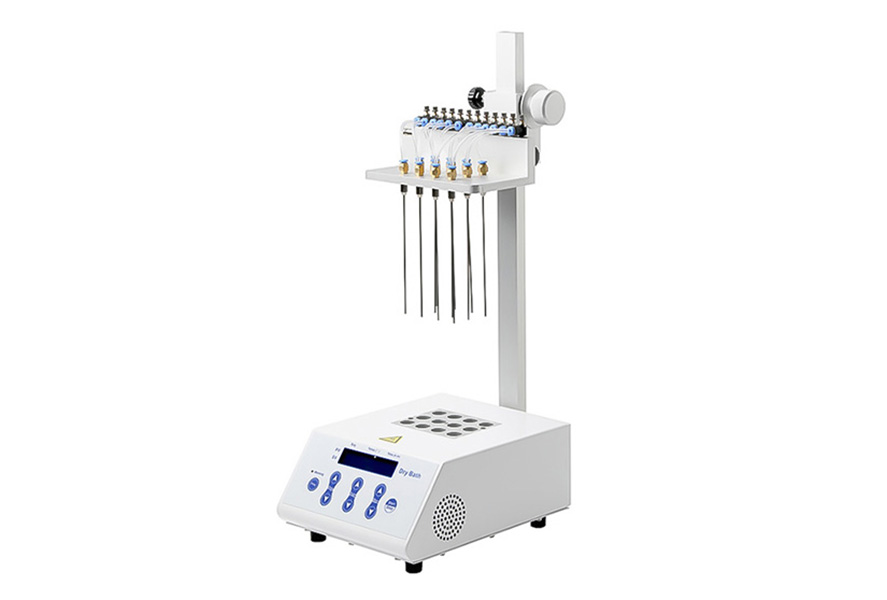


Shanghai Yetuo Liquid Crystal Dry Nitrogen Blowing Instrument is a domestically produced cost-effective sample concentration equipment, featuring precise PID temperature control, LCD liquid crystal display, and independent gas path control. Its core is aimed at sample pretreatment scenarios in laboratories such as food, environment, and medicine. Compared with water bath nitrogen blowing instruments, it is cleaner and more stable in temperature control, suitable for routine testing needs that pursue efficiency and stability.
1、 Core models and parameters (new in 2026)
The mainstream specifications of the Yetuo YTGT series are 12 holes/24 holes, and the parameter comparison is as follows:
Parameter item:
model | YTGT-12N (12 holes) | YTGT-24N (24 holes) |
Sample size | 12 digits | 24 digits |
Temperature control range | Room temperature+5 ℃~150 ℃ | |
temperature control accuracy | ± 0.3 ℃ (high standard) | |
display precision | 0.1℃ | |
heating module | Aluminum alloy dry module | |
heating rate | 20℃→100℃ ≤15min | |
air circuit control | 12 independent valves | 24 independent valves |
gas flow rate | 0~10L/min (total) | |
work pressure | ≤0.1MPa | |
timing range | 1min~100h | |
program control | 5-segment programmable program | |
power | 200W | 400W |
size | 255×200×540mm | |
net weight | 6.5kg | 7.5kg |
Module adaptation (optional accessories)
Standard adaptation: 10mm test tube/10mL centrifuge tube * * (commonly used)
Optional modules: 13mm, 16mm, 20mm aperture (to be purchased separately)
Module material: thickened aluminum alloy, resistant to oxidation, corrosion, and uniform thermal conductivity
2、 Detailed explanation of core functions
1. LCD intelligent control system (core advantages)
LCD large screen display: Real time display of set temperature/real-time temperature, remaining time, operating status, and fault codes.
Microcomputer PID temperature control: The temperature fluctuation is only ± 0.3 ℃, far superior to ordinary domestic models (± 1 ℃), ensuring stable sample recovery rate.
Multi stage program: supports 5-stage temperature/time programming, suitable for segmented concentration of solvents with different boiling points (such as n-hexane, methanol, ethyl acetate).
Timed/Automatic Shutdown: Set the time to automatically stop heating and gas path, prevent over blowing and prevent evaporation.
Overtemperature alarm: Equipped with a built-in temperature sensor, it automatically shuts down when the temperature exceeds 150 ℃ and provides sound and light alarms.
2. Dry heating system
Aluminum alloy module: Whole piece cast aluminum heating, no water bath pollution, no cross contamination, fast heating and cooling.
Temperature resistance range: up to 150 ℃, suitable for high boiling point solvents such as dimethyl sulfoxide and toluene.
Uniformity: The temperature difference between modules is less than ± 0.5 ℃, ensuring consistency in concentration of samples from the same batch.
3. Independent nitrogen purging system (gas saving+high efficiency)
Each independent valve: 12/24 gas needles can be opened and closed separately, with flow rate adjusted separately. Unused channels can be closed, reducing nitrogen consumption by more than 30%.
Adjustable needle holder: made of alloy material, with stepless height adjustment. The needle should be 1-2mm away from the liquid surface for optimal concentration efficiency and splash prevention.
Standard gas needle: 150mm in length, made of stainless steel, corrosion-resistant, and easy to clean.
Quick connector: The air circuit is easy to plug and unplug, and maintenance is simple.
4. An comprehensive and humanized design
Overtemperature protection+fault self check: automatic shutdown and prompt for temperature abnormalities and sensor failures.
Compact body: can be placed in a fume hood for more efficient handling of toxic solvents.
Operation panel: film buttons+LCD display, simple and intuitive, laboratory resistant to dirt and easy to wipe.
3、 Selection Guide (Select by Scene)
1. Select the model based on the sample flux
Select YTGT-12N (12 holes)
Applicable: Small batch samples (daily processing ≤ 20 samples), university teaching, enterprise research and development, and routine self inspection laboratories.
Advantages: Low price, small footprint, low power consumption, and simple maintenance.
Select YTGT-24N (24 holes)
Applicable: High throughput laboratories such as third-party testing, environmental monitoring, and food disease control (processing ≥ 30 samples per day).
Advantages: Processing 24 samples at once, doubling efficiency and increasing per capita processing capacity.
2. Select the configuration according to the experimental requirements
Basic requirements (bi selection)
Independent gas path: Bi must be selected (better than unified gas path for gas saving, cross contamination prevention, and sample parallelism).
Dry heating: preferred (cleaner than water bath, free of moisture pollution, more accurate temperature control, suitable for high temperature of 150 ℃).
PID temperature control: Bi must be selected (ensuring accuracy of ± 0.3 ℃ and stable recovery rate).
Advanced requirements (optional)
Multi specification module: often handles test tubes with different diameters (such as 10mL/15mL/50mL), it is recommended to purchase multiple sets of modules separately.
Nitrogen generator: For long-term and large-scale use, it is recommended to equip a generator (which is more economical, complete, and does not require air exchange compared to steel cylinders).
3. Key points for avoiding pitfalls
Do not choose non independent gas paths: Unified gas paths cannot be controlled individually, resulting in gas consumption, sample contamination, and poor parallelism.
Not selecting temperature control accuracy>± 1 ℃: large temperature fluctuations, fluctuating sample recovery rates, and easy rework.
Bi selected aluminum alloy module: Poor quality plastic/thin aluminum module with uneven heating and easy deformation.
Bi chooses over temperature protection: laboratory wide bottom line, preventing dry burning and fire disasters.
4、 Applicable fields
Food testing: pesticide residues, veterinary drug residues, food additives, heavy metal pretreatment.
Environmental monitoring: water quality (volatile phenols, pesticide residues), soil (PAHs, VOCs), and concentration of atmospheric samples.
Pharmaceutical and chemical industries: synthesis of drugs, extraction of natural products, concentration analysis of drugs in blood/urine samples, preparation of chromatographic samples.
Research universities: organic synthesis, analytical chemistry, biological sample concentration, teaching experiments.
5、 Summary of advantages and disadvantages
advantage
1. Extremely stable temperature control (± 0.3 ℃): The RSD of parallel samples is less than 5%, and the recovery rate is stable (89%~93%).
2. Independent gas path saves gas efficiency: Single path adjustable, suitable for simultaneous processing of multiple samples and different solvents.
3. LCD program control: simple operation, timed automatic shutdown, freeing up manpower.
4. Dry heating without cross contamination: suitable for samples with high temperature and cleanliness requirements.
5. Domestic high cost-effectiveness: The price is only 1/3 to 1/5 of imported brands, and the quality is stable.
deficiency
1. No automatic constant volume/optical sensor: manual supervision is required when near dry (this function is generally not available in domestic products of the same price range).
2. The shell is made of engineering plastic, and the workmanship is not as solid as the imported brands on the Gao end.
Conventional sample pretreatment: The YTGT series from Yetuo meets the national standard requirements and has a good balance between stability and economy.