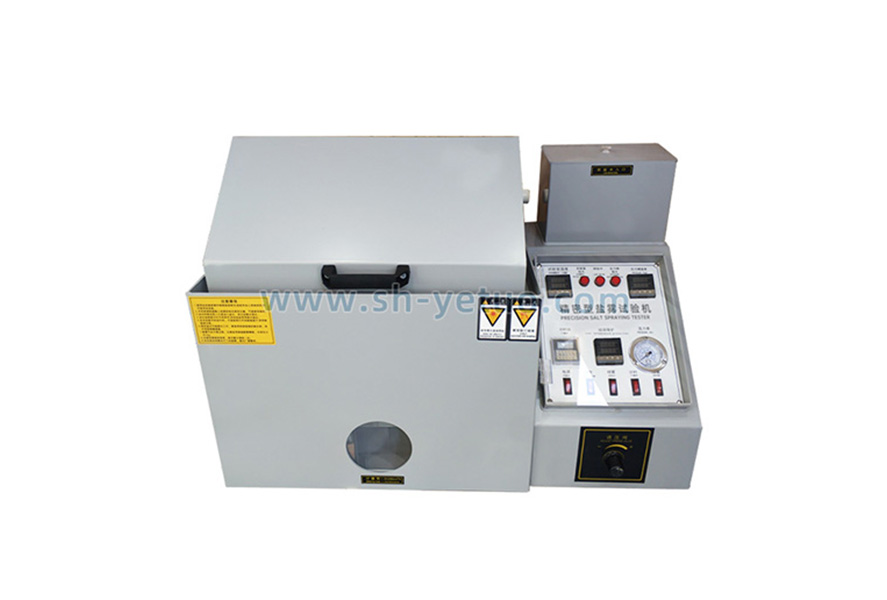



In the field of industrial manufacturing, the usability and reliability of products directly determine their market value and user trust. From outdoor communication equipment to automotive components, from marine engineering equipment to electronic components, they often require long-term exposure to complex environments with humidity and salt spray - and salt spray is the "invisible killer" that causes metal corrosion, coating failure, and functional damage. How to predict the tolerance of products in such environments in advance? The Shanghai Yetuo Salt Spray Test Chamber, as a core testing equipment that simulates harsh corrosive environments, has become an indispensable "rigorous examiner" in the industrial quality control process.
1、 What is a salt spray test chamber?
The salt spray test chamber is a device used to accelerate corrosion testing of products, materials, or coatings by artificially simulating salt spray conditions in natural environments. It is based on national and industrial standards (such as ISO, ASTM, GB/T, etc.) and key parameters such as salt spray concentration, temperature, humidity, spray pressure, etc., and can quickly reproduce corrosion scenarios in the laboratory environment, such as marine climate, industrial salt wet environment, so as to evaluate the core indicators such as salt spray corrosion resistance, coating adhesion, material stability, etc. of the sample.
Simply put, the core value of the Shanghai Yetuo Salt Spray Test Chamber is to compress the corrosion process that takes years or even decades to occur in nature into a matter of days or weeks, helping companies detect corrosion defects in advance during product research and development, production quality inspection, and factory verification, and avoiding accidents, economic losses, or brand reputation damage caused by corrosion problems in actual use.
2、 The core working principle of the salt spray test chamber is to replicate the "corrosive environment" accurately
The working logic of the salt spray test chamber revolves around the three major stages of "simulation control detection", and its core principle can be broken down into the following four steps:
1. Salt solution preparation: According to the test standard requirements, dissolve analytical pure sodium chloride (NaCl) in deionized water to prepare a specific concentration of salt solution (common concentration is 5%, some special tests need to adjust to 0.2%, 20%, etc.), and adjust the pH value of the solution (neutral salt spray pH 6.5-7.2, acidic salt spray pH 3.1-3.3).
2. Salt spray generation: The salt solution is atomized into tiny salt spray particles (usually 1-5 μ m in size) by compressed air, and then heated and kept at a constant temperature to stabilize the salt spray temperature at the set experimental value (such as the commonly used temperature for neutral salt spray test is 35 ℃, and the alternating salt spray test needs to switch between 35 ℃ and 50 ℃).
3. Environmental control: the stable temperature and humidity environment in the test chamber is maintained through the temperature control system and humidity regulation system, and the spray pressure valve and flow controller are used to ensure that the salt spray evenly covers the surface of the sample, and the salt spray settlement meets the standard requirements (usually 1-2mL/(80cm ² · h)).
4. Test cycle and observation: Set the test duration according to the testing requirements (ranging from a few hours to thousands of hours). During or after the test, observe whether there is rust, blistering, peeling, discoloration, or other phenomena on the surface of the sample, and determine its corrosion resistance level based on standards.
3、 The core type of salt spray test chamber: matching different scene requirements
Different industries and products have different tolerance requirements for corrosive environments, and corresponding salt spray test standards also vary. Therefore, salt spray test chambers need to be classified and designed according to the type of test. At present, the mainstream types mainly include the following three types:
Test Type: Neutral Salt Spray Test (NSS)
Core features: Simulate neutral salt spray environment (pH 6.5-7.2), moderate corrosion strength, widely applicable
Applicable scenarios: Conventional corrosion resistance testing for metal coatings, coatings, hardware components, automotive parts, etc
Reference standards: GB/T 10125-2021, ISO 9227:2017
Test Type: Acid Salt Spray Test (AASS)
Core features: Simulating acidic salt spray environment (pH 3.1-3.3), higher corrosion strength, and accelerated testing efficiency
Applicable scenarios: Products that need to be used in acidic and humid environments (such as coastal industrial equipment, electronic components)
Reference standards: GB/T 10125-2021, ASTM B368-09
Test Type: Copper Accelerated Acetic Acid Salt Spray Test (CASS)
Core feature: Adding copper ions in acidic salt spray results in the fastest corrosion rate and is suitable for testing with high corrosion resistance requirements
Applicable scenarios: Decorative coatings (such as chromium coatings, nickel coatings), precision electronic components
Reference standards: GB/T 10125-2021, ISO 9227:2017
In addition, for more complex practical environments, alternating salt spray test chambers (alternately simulating salt spray, dry, and humid environments) and cyclic salt spray test chambers (dynamically switching multiple parameters) can be customized to further improve the consistency between test results and actual usage scenarios.
4、 Application areas of salt spray test chamber: comprehensive protection from industry to people's livelihood
The application of salt spray test chambers has penetrated into multiple industries with high requirements for corrosion resistance, becoming a "must-have equipment" for product quality control:
Automotive industry: Testing body coatings, chassis components, engine accessories, etc. to ensure the corrosion resistance of vehicles in coastal, rainy and snowy weather, and to avoid structural failure caused by corrosion.
Electronic and electrical industry: Testing circuit boards, connectors, outdoor lighting fixtures, communication base station equipment, etc. to prevent salt spray intrusion from causing short circuits and signal failures.
Hardware and building materials industry: Evaluate door and window hardware, curtain wall accessories, fasteners, etc., to ensure their service life in outdoor humid environments and avoid rusting that affects the overall structure.
Aerospace and Ocean Engineering: Simulate high salt spray and high humidity environments for aircraft components, ship equipment, and ocean platform components to verify their long-term corrosion resistance and reliability.
Medical Device Industry: Testing the stability of coatings on surgical instruments and implantable metal components to prevent corrosion products from affecting human health.
5、 The core consideration for choosing a salt spray test chamber is that professionalism determines the testing value
For enterprises, when choosing a salt spray test chamber that meets their needs, they need to focus on the following four dimensions to ensure the accuracy, repeatability, and compliance of test results:
Standard compliance: Prioritize selecting equipment that meets mainstream industry standards such as GB, ISO, ASTM, JIS, etc., to ensure that test data can be recognized by customers and regulatory agencies.
Parameter accuracy: Pay attention to temperature control accuracy (preferably ± 0.5 ℃), stability of salt spray deposition, and pH control range, which directly affect the reliability of test results.
Equipment material and process: it is recommended to select 316L stainless steel with strong corrosion resistance for the test box, and the spray system is made of polytetrafluoroethylene (PTFE) to avoid the impact of equipment corrosion on the test samples.
Intelligence and ease of use: Choose devices equipped with touch screens, programmable control systems, data storage and export functions to facilitate setting up test procedures, recording data, and reducing operational complexity.
6、 Conclusion: Building "Reliable Quality" through "Strict Testing"
In the context of the transformation of industry towards "high-quality development", the corrosion resistance of products has become an important component of the core competitiveness of enterprises. The salt spray test chamber is not only a testing equipment, but also a "commitment carrier" for enterprises to product quality - it uses scientific and accurate simulation testing to help enterprises avoid risks in advance, promote product iteration and upgrading, and ultimately provide users with more user-friendly and reliable products.