
 Alibaba Store
 Tmall Store
 Jingdong Sstore

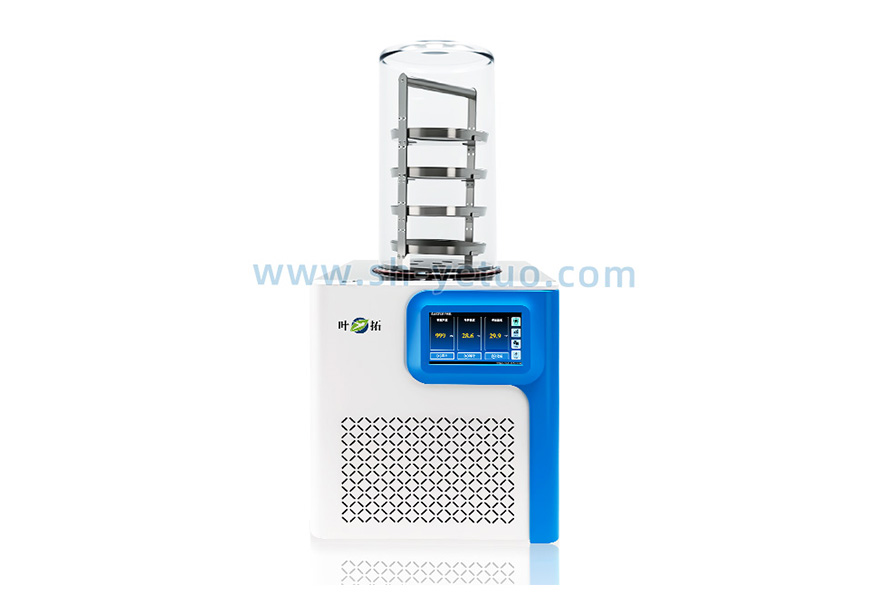
Have you ever wondered why adding water to space food can restore its fresh taste? How can precious bacterial strains and vaccines be preserved for a long time to maintain their activity? Why can animal and plant specimens in museums remain unchanged and undamaged for decades? The answer is hidden in the "low-temperature magic" of Shanghai Yetuo's new desktop freeze dryer (referred to as the "freeze dryer").
It is not an ordinary "dryer", but a precision equipment that uses special technology to "dehydrate and preserve" materials in a low-temperature vacuum environment. It can not only lock the original form and activity of materials, but also extend the storage period, making it a "time freeze" for materials. Jin Tian, let's unveil the mysterious veil of the freeze-drying machine.
1、 Freeze drying machine: not "drying", it is the dehydration art of "sublimation"
The traditional drying methods, such as sun drying and hot air drying, essentially turn the moisture in the material into a liquid state and then evaporate. But high temperatures can damage thermosensitive substances - such as the loss of vitamins from fruits, the inactivation of biological samples, and the breakdown of active components in medicinal herbs.
The core logic of a freeze-drying machine is completely different: it uses the principle of "three-phase change of water" to directly convert water from "solid ice" to "gaseous water vapor", skipping the liquid stage, and this process is called "sublimation". Simply put, it means "freezing" the moisture in the material into ice, and then allowing the ice to "disappear" directly in a vacuum environment, ultimately obtaining a dry material.
This "non melting direct sublimation" dehydration method fundamentally solves the pain points of traditional drying and makes freeze-drying machines a "must-have equipment" for high-value material processing.
2、 Three steps to complete the "time freeze": the entire process of freeze-drying machine operation
The operation of a freeze-drying machine is like a carefully designed "low-temperature dehydration ceremony", which is divided into three key steps that are interrelated:
Step Di: Pre freeze - Lock moisture into ice
First, place the material into the sealed chamber of the freeze dryer, and rapidly cool it down through the refrigeration system to freeze all the moisture inside the material into solid ice crystals. This process needs to be fast and thorough, and the temperature usually drops below -40 ℃ (different materials have different temperatures), in order to allow water to exist in the form of ice crystals and avoid damaging the material structure during subsequent sublimation.
For example, fresh strawberries, after being pre frozen, will turn into hard "ice strawberries" with almost the same appearance as when fresh, and the internal moisture will become small ice crystals.
Step 2: Sublimation drying - making the ice "disappear directly"
After the material is completely frozen, the vacuum system of the freeze dryer is activated to reduce the pressure inside the chamber to an extremely low level (far below the standard atmospheric pressure). In a high vacuum environment, the boiling point of ice will significantly decrease, and there is no need to heat it above 0 ℃. Ice crystals will directly sublime into water vapor and detach from the material.
This stage is the core of freeze-drying and also the most time-consuming step. For example, a piece of freeze-dried beef may take several tens of hours for the internal ice crystals to fully sublime, during which the chamber will maintain low temperature and high vacuum to ensure a smooth sublimation process.
Step 3: Analyze drying - remove residual water from the bottom
After sublimation drying, there will still be a small amount of "adsorbed water" (moisture attached to the surface of the material molecules) remaining in the material. This step is achieved by gentle heating (temperature still below the material's thermal sensitivity threshold) to allow the residual moisture to continue evaporating, ultimately reducing the material's moisture content to below 1% -5% and meeting the standard for long-term storage.
After completing these three steps, the freeze-drying process is over. At this point, the material's appearance, structure, and freshness are almost identical, with a loose texture that can be quickly rehydrated by adding water, restoring its original taste and activity.
3、 Why is a freeze-drying machine a "fresh-keeping fan"? Four core advantages
Compared to traditional drying methods, the advantages of freeze-drying machines can be called "crushing grade", which is also the reason why they can be widely used in the high-end field:
1. Lock in activity and nutrients without damaging the essence
Low temperature throughout the process (usually between -20 ℃~-50 ℃), anaerobic environment, can maximize the preservation of the biological activity of materials (such as strains, vaccines, enzyme preparations), heat sensitive nutrients (such as vitamins, proteins), and natural flavor. For example, freeze-dried vegetables have a vitamin C retention rate of over 90%, far exceeding the 30% -50% of hot air drying.
2. Retain the original form and have strong rehydration ability
Water sublimates in the form of ice crystals, without damaging the cellular structure and appearance of the material as liquid water evaporates. After freeze-drying, the material has a loose texture and is filled with tiny pores inside. Water can quickly penetrate and restore its freshness within a few minutes. For example, freeze-dried instant noodles can be brewed with boiling water for 5 minutes, and the taste is almost the same as freshly cooked noodles.
3. Extend the storage period without the need for preservatives
The material has an extremely low moisture content, making it difficult for microorganisms to grow and reproduce, and the entire process is in an anaerobic environment to reduce oxidation and deterioration. It can be stored for a long time at room temperature. For example, freeze-dried fruits can have a shelf life of 1-2 years without the need for preservatives; After freeze-drying, biological vaccines can be transported and stored at room temperature, significantly reducing logistics costs.
4. No pollution residue, pure and clean
The entire process is carried out in a sealed chamber, and the materials will not come into contact with external dust or bacteria, nor do they need to add any preservatives or desiccants. The final product has high purity and is suitable for fields such as food and medicine that require high integrity.
4、 From laboratory to dining table: the "wang application scenarios" of freeze-drying machines
The figure of freeze-drying machines has already penetrated into every aspect of our lives, from high-end scientific research to daily consumption, everywhere:
1. In the field of biomedicine: the "guardian" of active substances
This is the core application area of freeze-drying machines. Vaccines, antibodies, protein preparations, bacterial strains, blood products, etc. all need to be freeze-dried to preserve their activity and facilitate long-term storage and transportation. For example, vaccines rely on freeze-drying technology to be stably stored at room temperature and transported to various places around the world.
2. In the field of food processing: the "balancer" of deliciousness and nutrition
The freeze-dried coffee, freeze-dried fruits and vegetables, freeze-dried instant noodles, freeze-dried Congee, aerospace food and so on we ate are all masterpieces of freeze-dried machines. It makes food lightweight and easy to store while retaining its original flavor and nutrition, meeting the needs of fast-paced life. For example, freeze-dried strawberries are crispy and have a sweet and sour taste that is no different from fresh strawberries.
3. In the field of scientific research and specimen analysis: the 'freeze maker' of morphology
The freeze-drying machine used in university laboratories and research institutes to process biological samples, plant specimens, and insect specimens can fully preserve the morphology and structure of the samples, facilitating subsequent observation and research; Museums use it to restore and preserve cultural relics, such as damp ancient books, calligraphy and painting, bamboo and wood lacquerware. After freeze-drying treatment, it can avoid cracking and deformation, and can be preserved for a long time.
4. New materials and chemical industry: the "guarantors" of performance
Nanomaterials, polymer materials, fine chemical raw materials, etc., after freeze-drying treatment, can avoid agglomeration and oxidation, retain their original physicochemical properties, and provide stable raw materials for research and production. For example, the positive electrode material of lithium batteries can improve the cycle life and overall performance of the battery after freeze-drying.
5、 Summary of Science Popularization: The Core Value of Freeze Drying Machine
The essence of a freeze-drying machine is to use the physical magic of "low-temperature sublimation" to achieve dehydration and preservation without damaging the essence of the material. It does not involve complex chemical additives, only pure physical processes, allowing materials to "freeze" in a fresh state. This not only meets the strict requirements for activity and stability in scientific research and pharmaceutical fields, but also brings healthier and more convenient products to our lives.
From precision instruments in the laboratory to snacks on supermarket shelves, freeze-drying machines use low-key technological power to safeguard quality and freshness, becoming an indispensable "black technology equipment" in modern industry and life.